
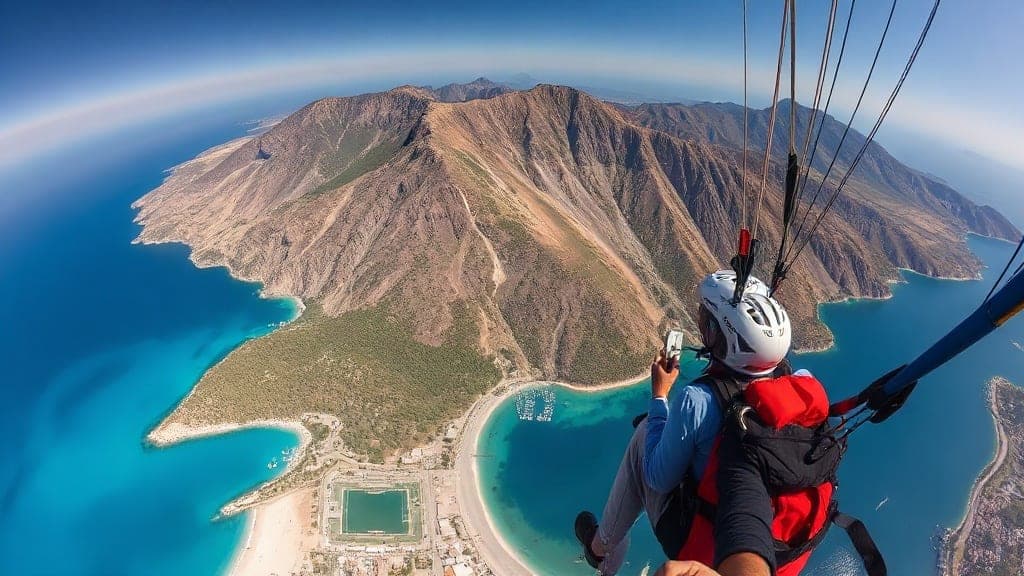
Ölüdeniz is one of the world's most iconic paragliding destinations, and the good news is that a physical disability does not have to keep you from soaring above the Blue Lagoon. Disabled paragliding in Ölüdeniz is genuinely possible for many people with mobility impairments, sensory differences, or hidden disabilities — though the right preparation and the right operator make all the difference. This comprehensive accessibility guide answers the questions we hear most from disabled travellers considering tandem paragliding in Ölüdeniz, so you can make a confident, informed decision before you book.
Can People with Disabilities Go Paragliding in Ölüdeniz?
Yes — many people with physical disabilities can go paragliding in Ölüdeniz, including wheelchair users, amputees, and passengers with limited mobility, provided a qualified tandem pilot assesses their individual needs in advance. The experience is tandem paragliding: you fly harnessed to an experienced instructor who controls the glider entirely, which means you do not need to run, balance, or operate any equipment yourself.
Ölüdeniz sits beneath Babadağ Mountain at 1,960 metres above sea level, offering a long, smooth glide over the turquoise Blue Lagoon and Mediterranean coastline — a flight profile that is actually well-suited to adaptive passengers because the air is typically stable and the descent gradual. The key variables are your specific condition, your body weight, and whether a pilot can safely support you at launch and landing. We assess each passenger individually, so the first step is always a conversation rather than an automatic yes or no.
What Types of Physical Disabilities Can Be Accommodated for Tandem Paragliding in Ölüdeniz?
Tandem paragliding in Ölüdeniz can accommodate a wide range of physical disabilities, including lower-limb amputations, paraplegia, hemiplegia, cerebral palsy affecting mobility, muscular conditions, and post-stroke limb weakness. Upper-body strength is helpful but not always essential, since the pilot manages all steering inputs.
Conditions We Regularly Fly With
- Lower-limb amputees: Passengers with single or double below-knee or above-knee amputations fly regularly. Prosthetics can usually remain on during flight.
- Wheelchair users and paraplegics: Seated launches (described below) make flight possible for passengers who cannot stand or bear weight on their legs.
- Hemiplegia and one-sided weakness: The pilot harness provides full support on both sides, compensating for one-sided instability.
- Cerebral palsy: Assessed case by case; spasticity levels and head/neck control are the primary considerations.
- Multiple sclerosis and muscular dystrophy: Possible depending on current mobility and fatigue levels — we recommend a detailed pre-booking call.
Conditions that may prevent participation include active, uncontrolled epilepsy, certain cardiac conditions, and severe spinal instability. We explain these in the medical restrictions section below.
How Do Pilots Adapt the Flight and Harness for Passengers with Limited Mobility?
Pilots adapt the tandem harness with wider seat boards, additional chest and leg straps, and custom positioning to support passengers who cannot maintain an upright seated posture independently. The adaptation process begins before you even leave the ground.
Harness Adaptations
Standard tandem harnesses already place the passenger in a reclined, seated position similar to a hammock chair, which naturally suits passengers with lower-limb disabilities. For additional needs, our pilots can:
- Add lateral torso supports to prevent side-lean during turns
- Tighten the leg loops asymmetrically for single-limb amputees
- Use a foam positioning insert to support the lower back and hips
- Adjust the hang point to shift weight distribution for passengers with uneven muscle tone
Seated and Assisted Launches
A standard Babadağ launch involves a short run of several steps — something passengers with lower-limb disabilities cannot do. For these passengers, our pilots use a seated launch technique:
- The passenger is harnessed and seated on a low stool or directly on the ground at the launch edge
- The pilot inflates the wing behind both of you while a ground assistant holds the harness steady
- As the glider rises and generates lift, both pilot and passenger are lifted smoothly off the ground — no running required
- A second ground assistant supports the passenger's legs until full lift-off
This technique requires calm launch conditions, which is one reason pilots will check the weather window carefully before committing a disabled passenger to the launch queue.
In-Flight Positioning
Once airborne, most passengers with lower-limb disabilities find the flight extremely comfortable — the harness does all the work. Pilots communicate by voice and will always ask how you are feeling during the flight. If you have limited neck or head movement, the pilot will avoid sharp turns that might cause discomfort.
What Should Disabled Passengers Ask Before Booking Paragliding in Ölüdeniz?
Before booking paragliding in Ölüdeniz with a physical disability, you should ask the operator directly about their experience with your specific condition, their harness adaptation options, the assisted launch process, and what ground support is available at both the launch site and the landing beach. Never book based on a generic accessibility statement alone.
The Essential Pre-Booking Checklist
Ask your operator these specific questions:
- Have your pilots flown passengers with my specific condition before? Ask for honest confirmation, not just general reassurance.
- Which harness adaptations do you have available on-site? Lateral supports, wider seat boards, and additional straps should be mentioned specifically.
- Do you offer seated launches? This is non-negotiable for passengers who cannot walk or run.
- How many ground assistants will be present at launch? You want at least two for a mobility-impaired passenger.
- What is your policy if conditions are not suitable for an assisted launch on the day? Ask about rescheduling and refund terms.
- Is there step-free access to the minibus, and will someone assist me boarding? (See the Babadağ access section below.)
- What does the landing procedure look like for someone who cannot stand? Pilots should describe a seated or slide landing clearly.
- Do I need a medical certificate? Some operators require a doctor's letter for passengers with listed conditions.
At Atmos Paragliding, we welcome these questions and will arrange a phone or video call with your assigned pilot before any booking is confirmed.
Are There Weight or Medical Restrictions That Apply to Disabled Paragliders in Turkey?
Yes — Turkish aviation regulations and operator safety policies apply weight limits and medical eligibility criteria to all paragliding passengers, including those with disabilities. These are safety requirements, not discrimination.
Weight Limits
The standard maximum passenger weight at most Ölüdeniz operators, including Atmos, is 110 kg (approximately 242 lbs). This limit applies regardless of disability status and is set by glider load ratings. In some cases, heavier-duty tandem gliders rated to 120 kg are available — ask specifically if you are close to the limit.
Medical Conditions That May Prevent Participation
- Uncontrolled epilepsy: A seizure at altitude or during landing is a serious safety risk. Passengers with well-controlled epilepsy (seizure-free for a defined period, on stable medication) may be considered on a case-by-case basis with a doctor's letter.
- Recent spinal surgery or unstable vertebral fractures: The harness applies pressure to the lower back and hips; spinal clearance from a surgeon is required.
- Severe cardiovascular conditions: Including recent heart attack, uncontrolled arrhythmia, or uncontrolled hypertension.
- Active dislocating joints: Shoulders or hips that dislocate without warning could be injured during launch or landing.
- Severe osteoporosis: The landing impact, even in a slide landing, carries some fracture risk.
If you are unsure whether your condition falls into a restricted category, bring a letter from your GP or specialist confirming you are medically fit for moderate physical activity and altitude exposure.
How Do You Get to the Babadağ Launch Site If You Have a Mobility Impairment?
Disabled passengers travel to the Babadağ Mountain launch site at 1,960 metres by minibus from Ölüdeniz village — the same route used by all paragliding passengers — and our ground team provides hands-on assistance with boarding, the mountain road journey, and movement at the launch area. There is no cable car or lift; the minibus is the only route.
What to Expect on the Minibus Journey
- The drive from Ölüdeniz to the Babadağ launch takes approximately 25–35 minutes on a winding mountain road
- Minibuses are standard-height vehicles; there is a step up to board — our team will physically assist wheelchair users to board and stow wheelchairs or mobility aids in the luggage area
- Passengers who use manual wheelchairs should inform us at booking so we can confirm the vehicle has adequate storage
- The road itself is paved but has switchback bends; passengers who experience motion sickness should take medication beforehand
At the Launch Site
The Babadağ launch area is a grassy plateau with uneven terrain. Wheelchair users will need to be supported by our team between the vehicle and the harnessing area — we use a carry-assist method with two team members. There are no ramps or paved paths at the launch site itself, so we manage this entirely through personnel support. Comfortable, supportive footwear is recommended for anyone who can partially weight-bear.
What Does Landing Look Like for a Passenger Who Cannot Walk or Stand Unaided?
For passengers who cannot stand or walk, pilots perform a seated or slide landing on the Ölüdeniz beach landing zone, touching down in a controlled seated position rather than running to a stop. This is a standard technique used regularly for disabled passengers.
The Slide Landing Technique
Instead of running out the landing, the pilot guides the glider to a very slow final approach speed and brings both passengers down to the ground in a gentle seated slide. Ground assistants positioned on the beach help slow the final movement and immediately support the passenger's position on landing. The landing beach at Ölüdeniz is flat, sandy, and well-suited to this technique. Your wheelchair or mobility aid will be brought to the landing zone by our team so you can transfer immediately.
Can You Paraglide in Ölüdeniz If You Are Deaf, Blind, or Have a Hidden Disability?
Yes — passengers who are deaf, blind, or have hidden disabilities including anxiety disorders, autism spectrum conditions, or well-controlled epilepsy can paraglide in Ölüdeniz, with appropriate communication adaptations made by the pilot before and during the flight.
Deafness and Hearing Impairment
Pilots communicate pre-flight instructions via written cards or a companion interpreter, and use agreed tactile signals (a tap on the shoulder, for example) during flight as alternatives to voice commands. British Sign Language and Turkish Sign Language users should let us know at booking.
Blindness and Visual Impairment
Visually impaired passengers fly regularly — the harness, launch, and landing process is described verbally in detail before the flight, and the pilot narrates the experience during the glide. There are no visual tasks required of the passenger.
Anxiety, Autism, and Sensory Sensitivities
We offer a pre-flight ground briefing at the launch site before harnessing, allowing passengers extra time to acclimatise to the environment, the equipment, and the sounds of the wing. Pilots can adjust the flight duration and avoid aggressive manoeuvres for passengers who have communicated sensory sensitivities. Please tell us at booking — this information stays confidential and only helps us plan better.
Well-Controlled Epilepsy
Passengers with epilepsy who have been seizure-free for 12 months or more on stable medication are considered individually. A letter from a neurologist confirming fitness is required. We will not fly passengers with active or poorly controlled epilepsy.
Which Ölüdeniz Paragliding Companies Have Experience Flying with Disabled Passengers?
Atmos Paragliding is one of the most experienced operators in Ölüdeniz for flying passengers with physical disabilities, with a team of qualified tandem pilots trained in harness adaptation and assisted launch techniques. When choosing any operator for paragliding accessibility in Turkey, prioritise experience over price.
Look for operators who can confirm:
- Named pilots with documented experience flying mobility-impaired passengers
- On-site harness adaptation equipment (not just standard kit)
- A clear assisted launch protocol and ground assistant team
- Transparent medical and weight eligibility criteria
- A pre-booking consultation process — not just a tick-box online form
At Atmos Paragliding, we have flown passengers using wheelchairs, passengers with spinal cord injuries, below-knee amputees, and passengers with a range of neurological and muscular conditions. We are proud of every one of those flights, and we take the responsibility seriously.
Disabled paragliding in Ölüdeniz is not just a possibility — for the right passenger with the right operator, it is one of the most extraordinary experiences imaginable. Floating above the Blue Lagoon, with the Mediterranean stretching to the horizon and Babadağ falling away beneath you, is a view that belongs to everyone. Our team at Atmos Paragliding is here to make that happen safely and confidently.
Ready to find out if you can fly? Contact us directly at atmosparagliding.com to speak with a pilot about your specific needs, ask every question on your checklist, and — when the time is right — book the paragliding flight you deserve.