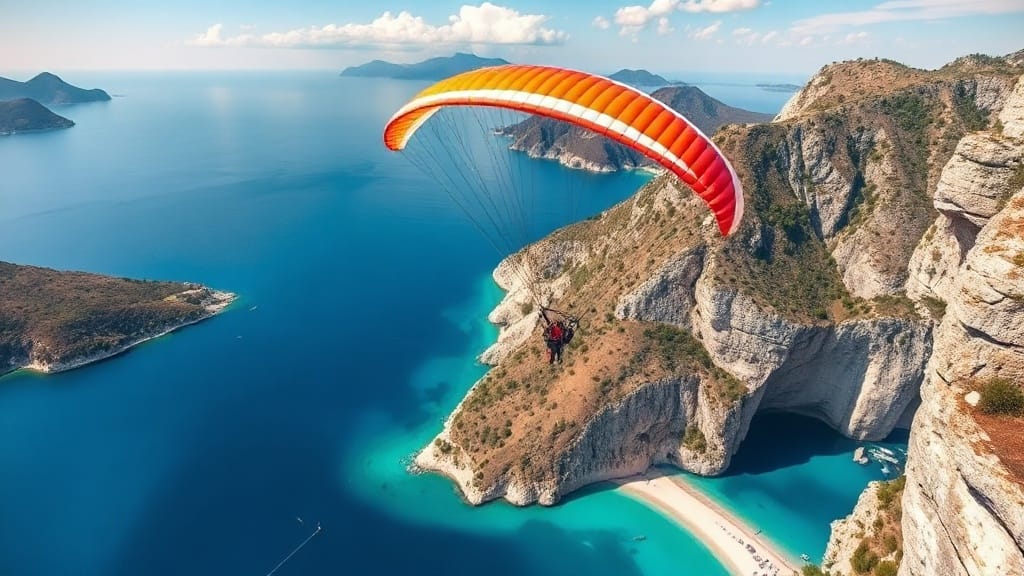
Detailed guide for pilots flying into Oludeniz.
A crosswind landing happens when the wind blows across the landing direction instead of straight down it. On the Ölüdeniz beachfront this occurs mainly when the breeze runs along the shoreline while the approach is flown over the sea.
For trained pilots this is routine: the technique is part of every professional tandem pilot's core skill set, practised thousands of times.
The key is a controlled 'crab' approach: the glider is pointed slightly into the wind while tracking straight along the landing line. Just before touchdown the pilot aligns the wing, flares, and the landing finishes into wind as much as space allows.
Pilots also adjust where they land along the beach — the zone is long, so there is always room to choose the segment with the cleanest wind.
Exactly what you do in every landing: keep your legs lifted until the flare, then stand or slide as instructed. The pilot handles all the directional work.
If conditions exceed safe crosswind limits, the flight simply lands at an alternative area with better wind alignment — decided well in advance, never at the last second.
Within limits, no — they are a standard technique every professional pilot masters. When crosswind exceeds safe limits, pilots move to an alternative landing area instead.
Possibly a slight sideways drift in the final seconds, corrected smoothly by the pilot just before touchdown. Most passengers do not notice at all.
Takeoffs are suspended when wind at launch or landing exceeds safe operational limits. See our wind guide — conditions are assessed continuously through the day.
Tandem flights all year round — daily in season (April–October), weather permitting in winter — one fixed $150 all-inclusive price. Book online or contact us directly.
